AI assistants and remote group decision making

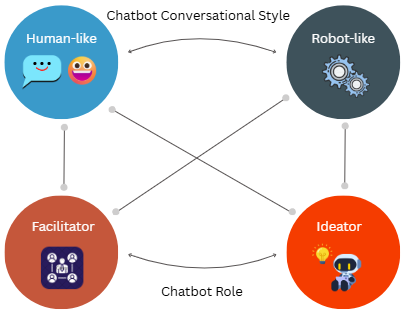
This project investigates how AI-driven chatbots can be designed to improve Collaborative Decision-Making (CDM) in remote work environments. By analyzing the interplay between a chatbot’s conversational style and its functional role, this study identifies specific design patterns that optimize for either team satisfaction, operational efficiency, or decision accuracy.

This work surfaces actionable insights into how AI behavior shapes collaboration, informing the design of AI systems that better support real-world, team-based decision-making.

[interface] interface of ai tool (for an ai saas company)

Methodology & Execution

Experimental Design: Conducted a 2*2 between-subjects experiment involving 60 groups (three human participants per team).

Variables Tested: Manipulated Chatbot Conversational Style (Human-like vs. Robot-like) and Chatbot Role (Facilitator vs. Ideator).

Technical Implementation: Due to time and budget constraints that prevented us from building four separate functional chatbots, we employed the Wizard of Oz (WoO) technique to simulate the AI's responses.

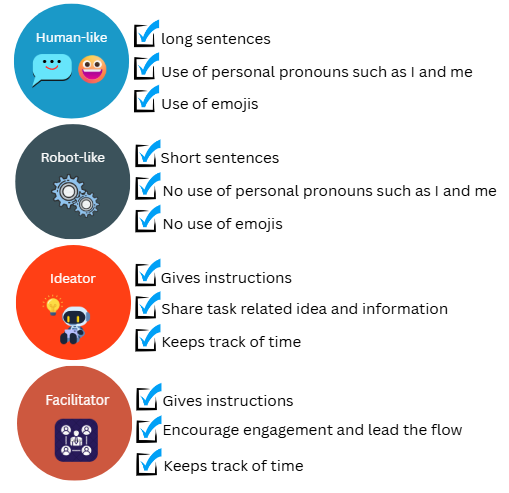
I designed four distinct scenarios ranging from a friendly "Ideator" to an efficient "Facilitator," each utilizing either a human-like or robot-like conversational style.  recruited two assistants who acted as the "wizards" behind the scenes to deliver the scripts. This allowed us to test exactly how different AI personalities affect team decisions with full experimental control, without the high cost of full software development.

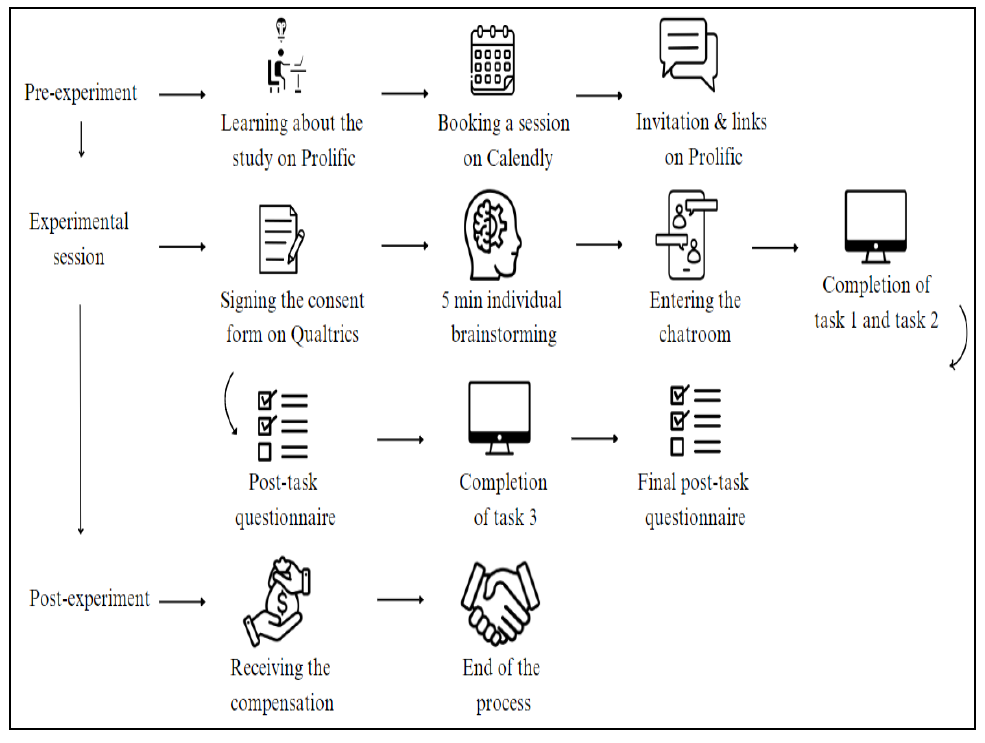
Task Structure: Teams completed a sequence of collaborative brainstorming, convergence, and rank-ordering tasks designed to measure performance metrics.

Experimental procedure

Key Findings & Insights

The findings of this study revealed that a human-like conversational style significantly boosts team process satisfaction by fostering a more engaging environment. This style was characterized by longer sentences, personal pronouns, and the use of emojis.

However, contrary to traditional UX assumptions, robot-like communication actually led to higher task efficiency. This was defined by concise and direct messaging which minimized social distractions and kept the team focused on the objective.

Decision making performance saw a marked improvement when the chatbot transitioned from a simple facilitator to an active Ideator that proactively shared suggestions. This change directly enhanced team accuracy during the tasks.

Finally, despite these AI-driven effects, interpersonal trust between human team members remained the primary driver of both process satisfaction and decision accuracy. This proves that the human element is fundamental to success regardless of the chatbot's specific design characteristics.

Practical Applications

To optimize the digital workplace, organizations should tailor AI personalities based on specific project goals by using robotic styles for speed-critical tasks and human-like styles for creative brainstorming.

This study demonstrates that while a human-like persona increases team satisfaction, a more direct and concise robotic persona effectively minimizes social distractions and enhances operational efficiency.

Furthermore, AI should be designed as an active Ideator rather than just a passive moderator because proactively offering suggestions measurably boosts the quality and accuracy of group outcomes.

By strategically matching these AI characteristics to the specific nature of a task, organizations can overcome the communication barriers inherent in remote collaboration and foster a more productive environment.